
The SARA software use approach is mainly Open Source based, although we always monitor developments in the area.
What is Open Source Software?
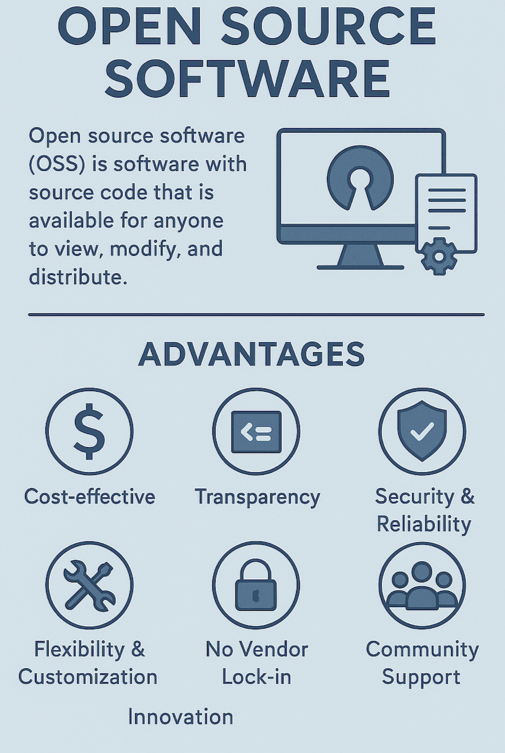
Open source software (OSS) is software with source code that anyone can inspect, modify, and enhance.
It’s developed in a collaborative, public way and is usually free to use. Common licenses like the MIT,
GPL, or Apache license define how the code can be used or shared.
Popular examples include:
• Linux (operating system) https://www.gnu.org/gnu/linux-and-gnu.html
• Firefox (web browser) https://www.mozilla.org
• LibreOffice (office suite) https://www.libreoffice.org/
• Git (version control system) https://git-scm.com/
• NextCloud (file Storage) https://nextcloud.com/
• Moodle (education) https://moodle.org/
• JupyterHub https://jupyter.org/, Spyder https://www.spyder-ide.org/ (programming environments, data science)
• Latex https://www.latex-project.org/ , Overleaf https://www.overleaf.com/ (programming to edit and formatting documents in science and education)
Mathematical software for science and education
• Octave (mathematical programming similar to Matlab) https://octave.org/
• SciLab (mathematical programming similar to Matlab) https://www.scilab.org/
• SageMath (mathematical programming with algebraic manipulations) https://www.sagemath.org/
• WxMaxima (mathematical programming with algebraic manipulations) https://wxmaxima-developers.github.io/wxmaxima/
• R (mathematical programming devoted to statistical analysis) https://www.r-project.org/
Advantages of Using Open Source Software
- Cost-effective
Most OSS is free to use, which reduces software costs for individuals and businesses. - Transparency
Since the code is open, users can inspect it for security, bugs, or hidden functions—no black boxes. - Security & Reliability
Open code allows many developers to audit and fix vulnerabilities quickly. The large community support
often results in stable, secure software. - Flexibility & Customization
You can modify the software to fit your exact needs—whether it’s adding features, removing unwanted
parts, or integrating with other tools. - No Vendor Lock-in
You’re not tied to one company’s ecosystem. You can switch support providers or host the software
yourself. - Community Support
Active communities often provide help, tutorials, plugins, and frequent updates. - Innovation
Because it’s open and collaborative, OSS often evolves rapidly and adopts new technologies faster.